


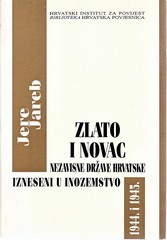
Jere Jareb: Gold and money of the Independent State of Croatia taken abroad in 1944 and 1945
From the review:
No works have been published in Croatia so far that would provide answers, based on serious scientific research, to the questions of the fate of the gold and property of the Independent State of Croatia, and thus also the confiscated or otherwise alienated property of its inhabitants, primarily Jews.
Dr. Jere Jareb’s book Gold and Money of the Independent State of Croatia Taken Abroad in 1944 and 1945 provides scientifically based answers to questions, claims and speculations about the gold and money of the NDH, sheds light on the problems of the confiscated property of its inhabitants and contributes to the research into the history of the Croatian economy in World War II. The book is the result of extensive research on sources (mostly in the Croatian State Archives) and in no part is it based on rumors and speculation, but rather provides valid answers based on strictly scientific, published documents.
The introductory part of the book presents the activities of the Croatian State Bank during World War II, which, as the central financial and issuing institution of the NDH, was, by its very nature, closely connected with the transfer of a portion of gold and other valuables abroad during 1944 and 1945. The remaining chapters provide specific answers to the questions of how much gold and other valuables were taken out of Croatia during the war, where these funds were taken out, and what their fate was. The first chapter of the book deals with the transfer of certain quantities of gold from Croatia to Swiss banks during 1944 and the subsequent fate of that gold. In the second and third chapters of the book, Dr. Jareb deals with the transfer of certain quantities of gold, money, and other valuables from the country at the very end of the war, on the occasion of the withdrawal of the authorities and armed forces of the NDH, as well as a large number of civilians from Croatia to Austria in May 1945.
Dr. Jere Jareb’s book answers many questions about the fate of the gold and money of the Independent State of Croatia. At the same time, it represents an important contribution to the elucidation of Croatian financial and economic history in the Second World War. This book is also an introduction to the necessary systematic research of the aforementioned problems, which, due to their topicality, do not belong only to the field of historical science. The vast archive material, partly preserved in Croatia itself, awaits future researchers whose scientific results should completely illuminate this part of our past.
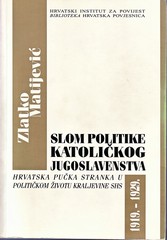
Zlatko Matijević: The collapse of the policy of Catholic Yugoslavism
From the foreword:
The emergence of Croatian political parties and their activities in the Kingdom of Serbs, Croats and Slovenes /Kingdom of Serbs, Croats and Slovenes/ (1918/1919-1929) is an important and unavoidable chapter in the history of the Croatian people. One relatively small, but not insignificant political party that operated in Croatia (Croatia proper, Slavonia and Dalmatia), and Bosnia and Herzegovina, during the parliamentary period of the Kingdom of Serbs, Croats and Slovenes, was the Croatian People’s Party /HPS/. By contemporaries, and later by Croatian (as well as former Yugoslav) historiography and journalism, it was most often referred to as a “clerical” or “clerical party”. The common name for members and supporters of the HPS was – “pučkaši” or, as they liked to call themselves, “pučani”.
The HPS is very specific in its origin – it was created as part of the unified Croatian Catholic Movement /HKP/, and was not a special phenomenon related exclusively to Croatia and Croats, but rather part of European movements among Catholic believers. Compared to the level of organization of Catholics in European countries (Germany, Belgium, Austria, etc.), the emergence of the HKP was several decades late. The decisive role in its systematic organization was played by strong incentives and concrete actions initiated from Slovenia.
The main ideological and political opponent of the Croatian Seniors was Stjepan Radić, who in ruthless confrontations almost completely marginalized their party. By deciding to have the president of the HPS enter the royal government, after the assassination of S. Radić, part of the leadership of the Seniorate dealt a fatal blow to their political organization. After the re-establishment of parliamentary life in the Kingdom of Yugoslavia, the Croatian People’s Party was not restored.
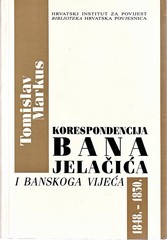
Tomislav Markus: Correspondence between Ban Jelačić and the Ban’s Council 1848 – 1850.
From the foreword:
The correspondence between Ban Jelačić and the Ban’s Council represents a significant historical source, especially for research into the Croatian political movement during the revolution in the Habsburg Monarchy in 1848-1850, namely its political, but also military, cultural, economic and ecclesiastical issues. In 703 documents, the author analyses the correspondence between Ban Jelačić and the Ban’s Council from September 1848 until the dissolution of the Council at the end of June 1850. The first document from this correspondence dates back to May 1848 and refers to Jelačić’s proposals to the members of the Ban’s Conference in Zagreb on the organisation of individual sections of the Ban’s Council and its members. The last documents are dated 25 and 26 June 1850 and refer to several letters from the Ban’s governor Mirko Lentulaj to Jelačić, that is, just one day before the Ban’s proclamation to the people in which he announced the introduction of a new political system in Croatia and Slavonia, and Jelačić’s thanks to the members of the dissolved Ban’s Council. According to the “Order of the Ministry of Internal Affairs on the Organization of Political Administrative Authorities in the Kingdom of Croatia and Slavonia” of 12 June 1850, a Ban’s government was established with the Ban at its head and directly responsible to the Vienna center. By the king’s decision, M. Lentulaj was retired, and his brother Benko became the sub-ban and president of the Ban’s government. The Ban’s government began its work in early July 1850, although some departments of the former Ban’s Council continued to operate until the second half of July, when they handed over their business to the newly established government bodies.
The material published in this book is mostly grouped in several holdings in two Zagreb archives; the majority of the letters are in the Croatian State Archives, a smaller number in the Archives of the Croatian Academy of Sciences and Arts, as well as in other archives, museums and libraries.
The correspondence between Ban Jelačić and the Ban’s Council will primarily be useful to historians in further studies of political, economic, cultural, ecclesiastical and other relations in Croatia, especially the area of Ban’s or civil Croatia in the period from autumn 1848 to summer 1850. It will also certainly be useful to archivists, university and high school professors, students and pupils, and everyone interested in that significant period of Croatian history in the 19th century.
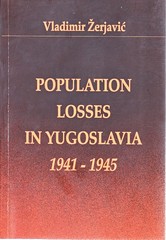
Vladimir Žerjavić: Population losses in Yugoslavia
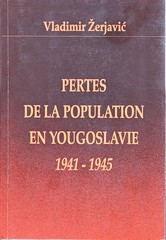
Vladimir Žerjavić: Pertes de la population en Yugoslavia
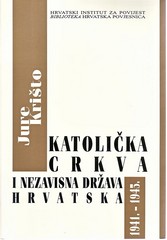
Jure Krišto: The Catholic Church and the Independent State of Croatia 1941 – 1945
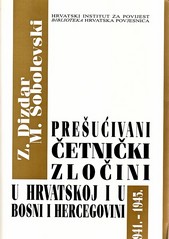
Zdravko Dizdar – Mihael Sobolevski: The Silenced Chetnik Crimes in Croatia and Bosnia and Herzegovina 1941 – 1945
From the foreword:
The Chetnik crimes of genocide against Croats and Muslims in Croatia and Bosnia and Herzegovina during World War II (1941-1945) were not accidental; they were a programmatically planned integral part of the military and political goals of the Serbo-Chetnik movement: the creation of a Greater Serbia, cleansed of the Croat and Muslim population through massacres. The source of these crimes lies in the understandings of Greater Serbia nationalists and expansionists that had been prepared for decades. According to the long-standing Chetnik doctrine, the surrounding national and historical territories of other peoples in which there are Serbs, regardless of their number, and also those territories in which there are no Serbs, but which the Serbs consider to be their geostrategic interest, must become Greater Serbia. Thus, they considered Bosnia and Herzegovina as a whole, and most of the present-day Republic of Croatia, to be Serbian western countries and sought to “cleanse” them of the Croats and Muslims there through the crimes of genocidal massacre, and then to include these non-Serb lands in the Serbian ethnically pure state of “Greater Serbia”. The constant advocacy of the Chetnik movement for the establishment of such and such a “Greater Serbia” in the aforementioned areas was one of the essential causes of the Chetnik terror and the crime of genocide, and not some religious and national diversity. The Chetniks expressed their genocidal views on all occasions: in numerous documents, maps, speeches, statements and practices on the eve of and during World War II. Horrible crimes were committed wherever the Chetnik units arrived. Their numbers depended solely on the military situation in the area. Tens of thousands of homes were looted, burned and destroyed, and around 300 villages and smaller towns were completely destroyed, a large number of Muslim mosques and Catholic churches and other historical and cultural monuments. In the most horrific way, the Chetniks killed tens of thousands of Croats and Muslims.
Until recently, the Chetnik crimes of genocide against Muslims and Croats could not and were not allowed to be systematically and comprehensively investigated and published, and the scale, cruel methods and means of committing the crimes remained unknown to Muslims and Croats, but also to the outside world. Historical experience with the repeated, Greater Serbian Chetnik aggression against the Republic of Croatia, and then to Bosnia and Herzegovina in 1991-1995. as well as in other areas, up to the most recent crime in Kosovo, shows that the obvious genocidal nature of Serbian policy has not yet been exhausted. The impunity of old sins has led to new crimes. Therefore, it is absolutely necessary to try all old and new Chetnik criminals, in order to prevent the return of the Greater Serbian ideology and force the Serbian people to no longer reach for other people’s territories in the future and to persecute their new ideologists of “Serbian lands” and “homogeneous Serbia” themselves. International actors must also be aware of this if they truly care about lasting peace and if they do not want to bear part of the responsibility.
responsibility for Chetnik crimes of genocide and their possible recurrence.
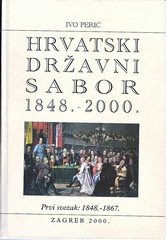
Ivo Perić: The Croatian State Parliament from 1848 to 2000, vols. I, II, and III.
Foreword from the book:
The history of the Croatian people is very rich and interesting. Its richness and interestingness are reflected in the active existence of many institutions, among which the Croatian State Parliament is one of the oldest and most important.
In the long history of the Croatian State Parliament, the longest period was the period of its estate-based structure. This period lasted from the second half of the 13th century until 1847. Until that year (1847), all parliamentary minutes were written in Latin. From 1848, the Parliament became a representative body, the modern Croatian parliament, with Croatian as the official language.
From the second half of the 19th century, when Croatian historical science began to develop more rapidly on a broader basis of research and use of original materials, there was a greater interest in parliamentary documents, and thus in the history of the Parliament. The first more enterprising research and publication of parliamentary documents was carried out by Ivan Kukuljević Sakcinski. In the third volume of his work “Jura Regni Croatiae, Dalmatiae et Slavoniae” (1862), he brought more than a hundred parliamentary conclusions from the period from 1273 to 1848. While collecting historical material for the Academy’s collection “Diplomatic Anthology of the Kingdom of Croatia, Dalmatia and Slavonia (Codex diplomaticus Regni Croatiae, Dalmatiae et Slavoniae)”, Tadija Smičiklas included some parliamentary documents in that collection. Very significant work in terms of the systematic presentation of parliamentary documents was carried out by Ferdo Šišić. He prepared for printing parliamentary documents from 1526 to 1630, and published them in the Academy’s collection “Monumenta spectantia historiam Slavorum meridionalium” under the title “Acta comitialia regno Croatiae, Dalmatiae et Slavoniae. Hrvatski saborski spisi” in 5 books, printed from 1912 to 1918.
This work, as it was started by Šišić, was continued and completed by the collaborators of the Croatian State Archives: Josip Barbarić, Josip Buturac, Ivan Filipović, Metod Hrg, Josip Kolanović, Mate Križman, Andrija Lukinović, Miljenko Pandžić, Mirko Stanisavljević, Ranko Sučić, Vesna Šojat and Bartol Zmaić, who prepared for printing and published in the Archive the remaining Latin-written parliamentary documents from 1631 to 1847 under the title “Conclusions of the Croatian Parliament” in 12 books, printed from 1958 to 1980. After this undertaking, the collaborators of the Croatian State Parliament: Josip Barbarić, Jozo Ivanović, Josip Kolanović, Andrija Lukinović and Vesna Šojat carried out another significant task: they prepared for printing and published in the Archive the Latin-written documents of the Conferences (parliamentary working bodies) from 1689 to 1848 under the title “Croatian Royal Conferences” in 5 books, published from 1985 to 1993.
By publishing these sources, an extremely useful piece of work has been done, which will significantly facilitate and accelerate the work of those researchers who decide to conduct a more thorough study of the history of Croatian class assemblies.
My research curiosity was attracted mostly by the recent history of Croatian parliamentary activity from 1848 to the present day. The first result of that curiosity was my book on the Dalmatian Parliament, published twenty years ago. The work of the Croatian Parliament in the second half of the 19th and throughout the 20th century can be followed on the basis of the mostly published stenographic minutes of its sessions, on the basis of various archives, as well as on the basis of newspaper and other reports. All of this was used in the preparation of this book, as was the literature on the Parliament and on general circumstances, about which information is provided in the accompanying notes. Given that all the literature consulted could not be included in these notes (in order to avoid their extensiveness), this literature will, of course, be additionally listed at the end of the third volume of this book.
This book consists of three volumes. The first volume – after an introductory overview of parliamentary activity up to 1847 – covers the period from 1848 to 1867. The second volume presents the
Bor work from 1868 to 1918. The third volume deals with the period from 1918 to the present day. Although the Parliament had various names at different times (until 1847 in Latin, and from 1848 in Croatian), it has always been the expression, representative and guardian of Croatian statehood, and therefore – taken as a whole – the name highlighted in the title of this book is the most fitting.
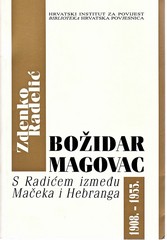
Zdenko Radelić: Božidar Magovac – with Radić between Maček and Hebrang
Summary from CROSBI:
Magovac was a supporter of the Radić brothers’ ideology and a member of the HSS, a collaborator of many important newspapers in Croatia, an editor and member of the editorial board of many newspapers and magazines, a dissident of the HSS and the Partisan movement, and a victim of a communist political trial. Magovac joined the People’s Liberation Movement, rejecting Maček’s policy of waiting and equal distance towards the Ustasha and Partisan movements. He believes that it is necessary to participate in the struggle because of the unacceptable policy of the Ustasha movement, but also to prevent the dictatorship of the Communist Party after the war. The KP accepted Magovac for two reasons: 1. to ensure the strengthening of the Partisan ranks with the Croatian peasantry, that is, Croats, 2. and to use him to break up the HSS, establish a new leadership of the HSS, and disable the much more dangerous opponent, Dr. Vladko Maček; 3. it wanted to use Magovac to manipulate the HSS in the struggle for power after the war, create the impression of the plurality of the Partisan movement, and conceal the revolutionary communist character of the war. However, although Magovac became an apostate of the HSS by going to the NOP, he insists on the equality of the HSS and the KP. That is why the KP, installing the pro-communist leadership of the IO HSS, rejected and interned Magovac. Even after the war, as during the war, Magovac is trying to become politically active again, imagining himself as a predecessor to the leadership of the HSS. He connects with Šubasic after his resignation in October 1945. They contact the communist leadership in 1946, which rejects their offer to include them in the government structure. Magovac was sentenced to 6 years in prison in 1947 on the basis of false accusations due to his political beliefs, and died two years after his release from prison in Stara Gradiška in 1955.
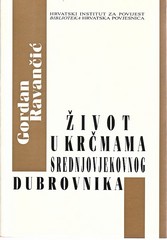
Gordan Ravančić: Life in the taverns of medieval Dubrovnik
From the foreword:
Life in the taverns of medieval Dubrovnik is a kind of, although not complete, but still clear picture of some issues of the social life of Dubrovnik in the late Middle Ages. There are many sources for studying this issue, but they are not sufficiently systematized, just as there are few works on Dubrovnik taverns, wine, wine trade and the like – in short, taverns and life in them are not sufficiently researched or are even almost unknown. In foreign historiography, especially in European, such topics have long been extensively researched. For example, English and German researchers have long argued that taverns, inns and other catering facilities of this type were centers of folk culture, both in the city and in the countryside.
The City of Dubrovnik’s circumstances, however, show that Dubrovnik taverns in the Middle Ages were different from most European catering establishments.
The structure of late medieval Dubrovnik was based on respect for tradition and internal contractual-legal relations that had been “petrified” by the mid-14th century. Seen in this context, the control over public life in the city and its surroundings was quite extensive. The wine trade and the city’s supply of wine were part of this system, i.e. taverns as places of retail wine trade and consumption.
The medieval Dubrovnik tavern had an important place in the life of the city as a gathering place and meeting place for the townspeople, small craftsmen and other visitors. As a gathering place, the tavern was part of the public space, an important part of the social reality of the medieval city.
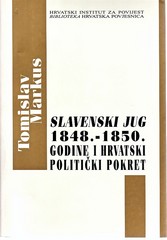
Tomislav Markus: The Slavic South 1848 – 1850 and the Croatian Political Movement
From the foreword:
Slavenski Jug, a political newspaper, was published in Zagreb from 6 August 1848 to 11 February 1850. It gathered around itself mostly Croatian and Serbian national activists, prominent publicists, writers and politicians, of various social backgrounds and members of the most important political and social institutions in Croatia in 1848-1849, such as the Ban’s Council, the Parliament, parliamentary committees and the “Slavenska Lipa na slavenskom Jugu” society. From the beginning to the end of its publication, the newspaper consistently advocated the Austro-Slavist idea of preserving and reorganizing Austria into a community of equal and sovereign nations. The newspaper was convinced that such a reorganization of Austria was a necessary condition for its survival. However, the basic aspiration of the newspaper was related to the narrow Croatian program, i.e. the realization of the widest possible independence and territorial integrity of Croatia within the reorganized Habsburg Monarchy.
Towards the Hungarian separatist movement, which aspired to the complete independence of the eastern part of the Monarchy, as Greater Hungary, from Vienna, the Slavic South had an extremely negative attitude. The constant condemnation of Hungarian separatism stemmed from the national exclusivity of the Hungarians, who did not recognize the sovereignty of any nation other than their own in Translajtania.
Slavenski Jug constantly emphasized the need for solidarity of the Slavic and, especially, South Slavic peoples of the Monarchy against common enemies – German centralism and Hungarian separatism and hegemonism. In advocating Slavic and South Slavic solidarity, the paper always started from Croatian national interests.
He affirmed the idea of modern nationalism with the concepts of national sovereignty, literacy and politicization of the people, introduction of representative civil institutions, especially parliamentarism and responsible government, public opinion and political democratic public, etc.
In considering European political trends, the most important thing for the paper was the state of the revolution and the position of conservative forces that sought to restore, as far as possible in individual countries, the situation before 1848.
In late 1848 and early 1849, Slavenski Jug attracted the attention of official Viennese circles with its writing, as well as some prominent Croatian politicians such as Ban Jelačić and the Croatian minister in the Austrian government, Franjo Kulmer. The position of the paper deteriorated significantly after the proclamation of the Occupied Constitution in Croatia; under the editorship of Bogoslav Šulek, the paper did not give up its consistent fight for the protection of Croatian autonomy and the Austro-Slavist reorganization of the Monarchy, so the Austrian government decided, through Ban Jelačić, to definitively ban Slavenski Jug in February 1850.
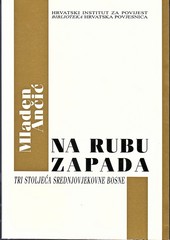
Mladen Ančić: On the Edge of the West: Three Centuries of Medieval Bosnia
From the foreword:
On the Edge of the West: Three Centuries of Medieval Bosnia, a book of treatises by Mladen Ančić, was created over the last fifteen years, on very different occasions and for very different reasons. These discussions, the author points out, are “firmly connected in the way that Umberto Eco once described, stating that in writing our entire lives we are actually looking for just one word. In this case, that one word should describe the history of the country in which the political formation that we today call “medieval Bosnia”, “Bosnian Banat” or “Bosnian Kingdom” was born and developed during the Middle Ages. Here, on the very edge of the European West, where that social space ended and another social space, that of the medieval European East, the “Byzantine Community of Peoples”, had not yet begun, an unusual and already exotic political community developed and lived for several centuries. Over the past fifteen years or so, I have been trying to understand how the development of that community proceeded, under what influences it was achieved and what results it yielded. In doing so, I have often tried to dispel historiographic myths about medieval Bosnia, which arose primarily from the political motives of modern historians, who were actually much more interested in the political present and future, and country but its medieval history.
Therefore, the reader who insists on reading the following pages should not be surprised by the extensive reviews of individual historiographical works with a sharp critical sting. Of course, it is up to the reader who has the patience to reach the end of the book to judge how convincing my arguments are in refuting the positions that I consider to be extrapolations of modern political programs. The same applies to the persuasiveness of the arguments on which my conclusions regarding some important issues are based. However, regardless of the persuasiveness or unpersuasiveness of these arguments and conclusions, I would be very pleased if, as a final result of everything I have said and written about medieval Bosnia, people began to speak and write in a way different from the one that has prevailed so far. Namely, it is about finally ceasing to view medieval Bosnia as a separate and self-sufficient microcosm, which had no connections or contacts with the rest of the medieval world.
Much of what happened in Bosnia from the 13th to the 15th centuries can only be understood from the context of the European Middle Ages, and to be precise, the Western Middle Ages. How convincingly I have managed to prove this basic idea I cannot judge for myself, but if it serves as an incentive and starting point for other and different discussions, my fundamental task will have been successfully accomplished.